Tuesday, September 27, 2011

Blogging Elul 5771: Did you remember to set your alarm clock?

This piece was published by one of our local weekly newspaper consortiums, Hersam Acorn, and appeared in print this week in the Amity Observer, Bridgeport News, Milford Mirror, and Trumbull Times.

This entry is my closing posting for Elul 5771.  I wish you all a Shanah Tovah um'tukah - a Sweet and Happy New Year.  May we all experience fully the blessing of life, and offer blessings to others through our words and deeds.
Rabbi Rachel Gurevitz

Rosh Hashanah, the Jewish New Year, which begins on Wednesday, September 28 in the evening, is a very different kind of New Year to January 1st.  ‘The Choosing’ is a recently-published memoir in which a Jew-by-choice and now Rabbi, Andrea Myers, tells the story of the first year her Italian-Catholic family encountered Rosh Hashanah.  She was living back at home with her parents and, after a long walk to a synagogue for evening services on the first night of the New Year, she returned home late, quite exhausted.  She was awoken at midnight from a deep sleep when her family, wanting so lovingly to help her celebrate, arrived in her bedroom clanging pots and pans, letting off streamers, and shouting ‘Happy New Year!’  The loud sounds more typically heard on Rosh Hashanah are the blasts of the shofar – the ram’s horn, and we usually hear those at the quite respectable time of late morning.  The shofar is, however, metaphorically, our communal ‘wake up’ call.

While the secular New Year is a time when many people make ‘New Years’ Resolutions’, the Jewish New Year marks a period of time when we first look back at our deeds from the past year.  Our worship liturgy speaks of God who holds us accountable, but the inner work that the New Year requires of us is really about how we hold ourselves accountable and take responsibility for our mistakes, the hurt we have caused others, and the ways we have behaved unethically or thoughtlessly.  If we really engage in this spiritual work, we can emerge ten days later, at the end of Yom Kippur – the Day of Atonement – transformed.  If we have the courage to speak to those whom we have hurt, and ask forgiveness, we can transform the relationships we have with others.

In the world we live in today, it almost feels deeply unfashionable to talk of a spiritual practice and a faith community that asks us to engage in a personal accountability inventory in this way.  There are those who speak in the name of faith, or offer spiritual paths, that emphasize what these things can do for you.  What about what we can do for others?  Faith is not about wish fulfillment.  It is about the meaning and purpose of our very existence as human beings.  It is about being fully present to life and to each other in all of the downs as well as the ups.  It is about the hard work of doing things together as communities with shared values, recognizing that no one person is more important than another, yet at the same time each and every one of us is necessary and has a unique voice to add as we work together to make things better.

As the Jewish community arrives at Rosh Hashanah, my hope and prayer is that we can learn from the wisdom of our ancient faith traditions, and hear the sound of the shofar as our alarm clock, reminding us of the perils of living in too much of ‘me’ society and not enough of an ‘us’ society.  The spiritual work of taking account, repairing what we can, and rededicating ourselves to the future takes courage and strength.  May we, by coming together, give each other the courage and strength that we need.
Shanah tovah u’m’tukah – May it be a sweet and good year for all.

Tuesday, September 20, 2011

Blogging Elul 5771: Lighting the way to peace

Have you been following the Jewels of Elul this year? Craig Taubman, musician, compiles short daily postings from a wide range of contributors on an annual theme that is woven into the pre-High Holyday month of Elul.  This year the theme is 'light' and postings have come from authors, politicians, musicians, activists and spiritual leaders from all walks of life, Jewish and non-Jewish.

I always find the Jewels of Elul to be insightful, but this year the most powerful posting that I have found so far came not from one of the official contributors, but from the page where anyone can leave a comment.  Craig received a short teaching from the great Jewish teacher and leader of the twentieth century, Rav Kook.  It was sent to him by Don Abramson. He shared it on the comments page.  I'm re-sharing it below.  It speaks for itself.

“There are those who mistakenly think that world peace can only come when there is a unity of opinions and character traits.  Therefore, when scholars and students of Torah disagree, and develop multiple approaches and methods, they think that they are causing strife and opposing shalom.  In truth, it is not so, because true shalom is impossible without appreciating the value of pluralism intrinsic in shalom.  The various pieces of peace come from a variety of approaches and methods which make it clear how much each one has a place and a value that complements one another.  Even those methods which appear superfluous or contradictory possess an element of truth which contributes to the mosaic of shalom.  Indeed, in all the apparent disparate approaches lies the light of truth and justice, knowledge, fear and love, and the true light of Torah.”
Olat HaRe’iah
 Rabbi Avraham Yitzchak Kook

Friday, September 16, 2011

Blogging Elul 5771: Connected in so many ways


Last night I came home from Congregation B'nai Israel after a long a day uplifted and inspired.  The inspiration was sparked, in large part, by the last thing I saw before leaving the building.  The Board of BIFTY, our Temple Youth Group, had gathered together for an evening of preparation work.  On the surface, mundane and repetitive tasks were the order of the evening - one group were busy stapling flyers and envelopes onto 800 paper bags.  Another group was stuffing envelopes.  So what was so inspiring?

First, the room was full - almost every single member of the board was present, from Freshmen Reps through to the Juniors who are our current leaders.  School has just got up and running, and here they were giving of their time to the hard work that goes on behind the scenes of successful programming and Youth group activity.

Second, the work they were doing, beyond bringing them together to connect with each other, represented the start of a chain, the ends of which we will never know entirely or personally.  The bags they were preparing are bags that they will hand out on Rosh Hashanah to all of our congregants.  Our congregants will bring them back filled with groceries on Yom Kippur, and our Youth Group will empty them into our Connecticut Food Bank Truck and recycle the bags.  What was work, but also shmooze time, and youth group program planning time, will spin off from that one hour last night to hundreds of people receiving food to supplement their family meals in a matter of weeks.  Our youth, through this simple act, will generate a response from hundreds in our congregation, helping them all do something small to make a difference in the lives of hundreds more.
BIFTY loading the CT Food Bank Truck on Yom Kippur last year
The other mailing they were preparing is being sent to every 9th through 12th grader connected to our congregation, inviting them to be a part of this incredible youth group.  Again, in the busy and hectic worlds of our teenagers, I realize that something that might seem so small is in fact huge.  I witnessed the enormous pleasure of members of the board arriving and reconnecting with each other after the Summer, and their enthusiasm to share the experience with others - with weekly programs, regional NFTY NE events (excitement is building for the Levi Leap annual dance on October 3rd), social action activities, and more.  The sense of identity, belonging, and leadership that builds from the social community that our teens create for themselves will spin out to manifest in ways still unknowable, likely to impact the rest of their lives.

Walking into our Youth lounge last night, I left inspired because what I witnessed was an example of lives lived in the context of community.  Perhaps especially inspired because these teenagers instinctively 'get it', or certainly recognize the added meaning it brings to their lives and are willing to exert the effort that it takes to create their own community and make a difference in the lives of others.

As we reflect on our day-to-day lives, the ways in which we exert energy, the communities we are a part of, the ways we actively contribute to them, and the ways in which the small acts we do in these contexts spin out to impact the lives of so many others, known and unknown, let the youth leadership of BIFTY inspire us all.  We should never underestimate the power of our actions, and our inactions, to shape the communities and the society of which we are a part.
Shabbat Shalom
Rabbi Rachel Gurevitz

Friday, September 9, 2011

Blogging Elul 5771: On the 10th Remembrance of 9/11

9/11 Memorial, World Trade Center Site, NYC
As the attention of millions is brought back to events of 9/11 ten years ago, there are countless voices offering their commentaries, their explanations, and their analysis. Our world is turned upside down by acts of hatred and violence, whether the scale be as large as the events of 9/11, or it is the experience of one individual family whose lives are forever changed when a loved one is violently taken from them.

We find ourselves torn from the ordinary, everyday, where we have an unconscious expectation that one day will proceed much like the one before.  The sense of certainty and security we have about the existence of the next moment of our lives is shaken.

There is certainly a time and a place for conversations and actions designed to restore our sense of safety and security again.  It is not psychologically healthy to live in a state of anxiety about what might be around the next corner.  But we might also be reminded that, living in a state of humility, we must accept that the only moment we can ever really know is this one, right now.

There is a time and a place for analysis of what took place on 9/11, and the responses that followed - at an individual, national, and international scale.  But there is also a time for silence.  A time to stand with individuals and a country remembering those who died.  A time to remember the acts of giving and bravery by so many in what turned out to be their last moments.  A time to face the monster that is a face of humanity too - our ability to commit great acts of violence against each other.

In this moment I do not seek meaning or explanation.  But I am spurred to respond.  I am reminded, as I so often need reminding, to live each day fully, to love as fully as I can, to never leave the words that I could say today until tomorrow.  I forget this all the time.  We all do.  We don't need acts of terror or national tragedies to remind us; this month of Elul leading up to Rosh Hashanah and Yom Kippur - two days that symbolize birth and death respectively, with only 10 days between them - these are part of the rhythm of the Jewish year so that we can pause and consider what we are doing with this gift of existence that we have been given without needing trauma to help us remember.

May the memories of all who died on 9/11 be a blessing in the hearts of all who mourn.

Join us at Congregation B'nai Israel on Sunday morning, 9:45 am, for a morning service of prayer, remembrance and reflection.
We will then join with many other communities of faith, including local Christian and Muslim communities, for an Interfaith outdoor service at The Fairfield Museum, 370 Beach Road, at 3pm.  The names of all those who died on 9/11 from Connecticut will be read as part of this ritual that will include readings and music.  All are then invited to join Sacred Listening Circles inside the museum to share memories, reflections, and hopes with other local residents in facilitated small groups.  The museum also has a photo exhibit on display in remembrance of 9/11.

Wednesday, September 7, 2011

Blogging Elul 5771: Reflections on our enemies

Today's blog entry is by student Rabbi Lisa Kingston.  Lisa was our rabbinic intern this Summer.  She is a fourth year student at Hebrew Union College, New York.  She delivers her Senior Sermon next Thursday morning during the morning service at the college.

Psalm 27:
The Eternal is my light and my salvation; whom shall I fear?
The Eternal is the stronghold of my life; of whom shall I be terrified?
In my very guts came evil to gnaw and consume me,
But these my troubles, my enemies, stumbled and fell.

Though an army encamp against me, my heart will not fear;
Though war rise up against me, even then I will keep faith.

During the days of Elul it is traditional to read Psalm 27, an affirmation of God’s help and protection when enemies surround us. Today, we may understand it as a plea for God’s help in dealing with the enemies within us. These are the demons of our own true self who frighten us away from living the lives we want.

I think one of the largest demons that can consume us is self-doubt. A friend of mine is studying to be a psychologist and she told me of an interesting conference she recently attended. Instead of wearing traditional nametags, each person in the room was asked to write their biggest fear and wear it upon their chest. One might assume participants would share silly things like a fear of heights or spiders, but people took the exercise to heart and shared what really unnerved them. They shared fears of failure, fears of being a fraud, fears of not being able to help people in the way they hoped, fears of letting down family members, and fears that they were not worthy of their success. We all share fears like these even when we appear confident and successful.

            Don’t worry, you wont be asked to wear the badges of your fear publicly this year, but Elul is the time to try to name and face your fears. When you arrive to Rosh Hashanah services this year, try to have at least one fear you want to address written on your heart. Identifying what holds you back can begin your steps to teshuva.

Friday, September 2, 2011

Blogging Elul 5771: Finding full humanity

Today's blog is by Rabbi Debbie Young-Somers, a colleague in the UK, and one of the Rabbis of the West London Synagogue of British Jews - the founding synagogue of Reform Judaism in the UK.  She is a regular on 'Pause for Thought' - a  faith-based message featured on BBC Radio 2.  Follow Rabbi Young-Somers blog here.
In large part Ellul is here to give us time to consider our relationships with each other and heal them, so that we might more fully return to ourselves and to God on Yom Kippur. Sometimes this may mean making a direct approach to someone and acknowledging that what you said or did was wrong and/or caused pain and apologising for this fact. Today, however, purely by chance, I was reminded that sometimes it's also about having very normal day to day exchanges and experiencing and being open to the full humanity contained in them. It was a very small thing really, but one that was the perfect start to a busy day and a busy shabbat. When I don't have time to make challah (special bread for shabbat) I tend to end up buying it in our local Arabic shop Solomon's, which picks up 2 boxes of challot, bagels and rye breads from a kosher bakery in Hendon every Friday. During the last month I've apologised to them for buying such good smelling bread when they are fasting, and they have grinned appreciatively. This morning I asked how Eid had been for them, and at the end of the conversation, the sales man wished me Shabbat Shalom. Of course this isn't going to change the world. But it changes my immediate surroundings, and brings a humanity to what is otherwise a very sensible business venture for them and a wonderful convenience for me. Building slowly slowly on trust between individuals, perhaps we can, step by step, create a sense of comfort and joy in our beautiful differences which are, after all, what make us human and interesting. So while during Ellul we look to improve the relationships that are perhaps more meaningful and long term, we can also take the opportunity to explore those relationships that are more functional, and instil in them human warmth and encounter, building local community, and appreciating our differences. Shabbat Shalom

Wednesday, August 31, 2011

Blog Elul 5771: Entering the holy of holies each and every day


Today is Rosh Hodesh Elul.  Inspired by Rabbi Phyllis Sommer, this year I'll be sharing postings a few times a week in the month leading up to Rosh Hashanah, and cross-posting some of my favorites from others who are doing the same.  If you use Twitter, you can see who else is blogging their way through the month of Elul by following #blogelul
Artwork by Michael Noyes: michaelnoyes.com
The Hebrew letters of the month of Elul, Aleph, Lamed, Vav, Lamed, were transformed in rabbinic commentary into a representation of the phrase from Song of Songs, Ani l'dodi v'dodi li - I am my beloved's and my beloved in mine.  The 117 verses of love poetry that make up the Song of Songs, absent of the explicit mention of God, are a bit of a mystery - why are they part of our holy canon?

Rabbi Akiva argued that this book was like the holy of holies in the Temple; he said that when the messiah came we wouldn’t need all of the commandments in the Torah, but we’d still need the Song of Songs.

The holy of holies was meant to be the innermost part of the Temple in Jerusalem. It was believed to be the place where the High Priest came closest to sensing the Presence of God.

The Song of Songs is an erotic book, but not in the sense that we usually use that term in common language. The love imagery of Song of Songs takes us to a place that is more experiential. It is sensual because it engages all of our senses and the poetry gives us a feeling of something that is very difficult to capture in words. A bit like love itself. We know it when we feel it. I once heard someone describe the holy of holies as being ‘on the inside of the inside’. Being so completely present in the moment that you completely lose the sense of separation. As soon as you notice this, you are no longer in it. I think that can sometimes be the experience of love, but it can also be the experience of listening to a symphony, or hiking up a mountain, or reading a book, or watching your child sleep in their bed.

These are deeply spiritual experiences… or they can be. The poetry of the Song of Songs uses love only as an example. And the Song of Songs makes no explicit mention of God. Yet our tradition suggests that it is when we have these kinds of spiritual experiences – when we are on the inside of the inside and so completely present to the moment we are in – this is the closest we might come to feeling the presence of God.

There are many people who don’t feel comfortable using the ‘G’ word to describe these kinds of experiences. That is partly due to the idea of God that we have inherited from many of our holy texts, and generations that have gone before us, not serving us well in the world we live in today. They were the best attempts of an ancient people to understand their most deeply felt experiences. But, as Rabbi Irwin Kula suggests, maybe its time for a new God – time for new conversations that help us talk about our most deeply felt experiences in ways that help us make meaning in our lives.

Those who have read recent entries in this blog will know that I recently returned from a social action trip with some of my congregants to help rebuilding efforts in Alabama. We worked in a small town called Cordova – about 40 minutes outside of Birmingham. It was a very powerful experience for us, and one of the things we were immediately struck by was the deep language of faith that pervaded the way people there understood their world. And so we were not volunteers coming to help for a week, but ‘God’s hands here to do God’s work.’ I confess, it took us aback a bit. We North Easterners aren’t used to thinking about our lives that way. And yet, our group was deeply moved by it – we recognized that the language they used elevated the way we thought about each little thing we did there and each interaction we had with the people who lived in Cordova.

I think that’s the secret of the Song of Songs. Its just a book of love poetry, or it’s the holiest book that we have. And the holy of holies is just another room in a man-made Temple, or it’s a place where one can feel God’s presence intensely. Whether it is ordinary or holy, a mundane or a spiritual experience, depends on whether we are paying attention, being fully present to the experience, and willing to label these moments of our lives in significant ways or not.

And I think that’s why the month of Elul is connected to the phrase from Song of Songs, ‘Ani l’Dodi v’dodi li’ – I am my beloved’s and my beloved is mine. We are invited to pay extra attention this month – to experience life more deeply and reflect on the meaningful moments that can be felt in the midst of the most ordinary of days. This is Jewish mindfulness practice.

As we move toward a New Year, with good intentions to move away from judgment, harshness, anger, impatience, intolerance, and many of those other sins we declare during the high holydays, Elul invites us to see our attempts to be more compassionate, kind, generous, patient, understanding as a spiritual practice.

We sing on Rosh Hashanah and Yom Kippur:
Adonai, Adonai El Rachum v’chanun. Erech apayim, Rav chesed v’emet. Notzer chesed la’alafim, nosei avon vafesha, v’chata’ah v’nakei 
The Eternal One, A God merciful and gracious, endlessly patient, loving and true, showing mercy to thousands, forgiving iniquity, transgression, and sin, and granting pardon.

Maybe we are God’s hands doing God’s work. And maybe these words are there to remind us of who we most want to be in the world.

Monday, August 15, 2011

An unforgettable experience in Alabama: Closing thoughts from our Social Action organizer

Lorrie Wexler is a member of Congregation B'nai Israel and serves on our board.  Active on our Social Action Committee, Lorrie was responsible for all coordination of our service trip to Alabama, corresponding with Bob Gross, our wonderful point person at Temple Emanu-el in Birmingham, booking our flights, and bringing us all together.  We leave the final words on our week's experiences to her.


When Rabbi Gurevitz asked me to write the last piece for the blog, I immediately felt a sense of pride.
To think this all began with an email sent to Rabbi Prosnit from Rabbi Miller from Temple Emanu-el in Birmingham, Alabama asking for help with the tornado relief. Three months later we had 12 remarkable people volunteer to help a community in need, just because.

We arrived in historical Birmingham on Monday and by Tuesday afternoon we were in a town called Cordova diving into the work that needed to be done. Cordova became our community that week and we became theirs. Just by being there gave the people who had lost everything a feeling of hope. It was an eye opener for us to learn about their faith, their way of life and delicious culinary delights like vegetable goulash, fried green tomatoes and fried okra.

The church in Cordova was a central location for volunteers to find tools to rebuild homes, eat lunch and dinner, choose furniture and every household item imaginable. These were all donated items.
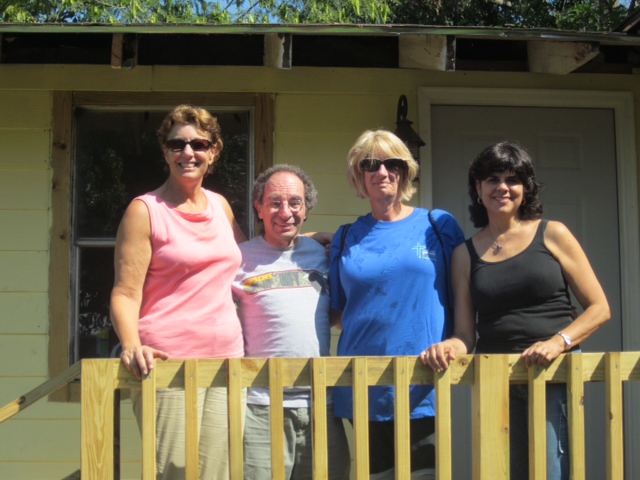
Suzanne Phillip, George Markley, Lorrie Wexler and Elaine Chetrit outside house no. 1
One afternoon we were fortunate to have the family whose house we were working on stop by. The look on their faces was pure joy.

They never imagined that this house could even be salvaged, let alone turned into this wonderful home that would enable them the opportunity to rebuild their lives. Through our hard work we turned their house into something that was warm and inviting. We schlepped furniture, primed walls, planted trees, put a brick walkway in, hung shutters and stocked their kitchen.
Rabbi Gurevitz, Ari Matz, Emma Pearlstone and Brittany O'Connell
outside House no. 2
The social action committee would like to thank Margo Schiff, Lisa Knicos, George Markley, Suzanne Phillip, Steven Soberman, Andrew Soberman, Elaine Chetrit, Brittany O’Connell, Ari Matz, Emma Pearlstone and Rabbi Rachel Gurevitz.
Andrew having way too much fun on a tractor

This wonderful group of people volunteered their time and their own money to make this happen.
We worked hard together, sweated together, laughed together and cried together.
What a truly gifted community of people to share the week with.
Lorrie Wexler


Below is some video footage that shows the devastation caused by the tornado in Cordova in the immediate aftermath - while most of the debris had been cleared by the time we arrived, the scale of the destruction gives some sense of what it means to rebuild this community:


Friday, August 12, 2011

B'nai Israel service trip to Alabama: The youth perspective

Today's blog entry from our social action volunteers in Alabama is written by our three teen participants, Ari Matz, Brittany O'Connell, and Emma Pearlstone
Beginning to take down and recycle cinder blocks, one by one
Hello from the jew crew in Cordova, Alabama! Helping in the relief efforts continues to be an exciting adventure for all of us. Being the energetic youth of our group, Ari, Emma, and Brittany were able to help. We spent today tediously chiseling cinder blocks off a partially demolished garage. In order to recycle the blocks for another house, we had to individually remove all of the cement from the edges of the blocks. On prior days of working we were in the midst of cleaning and organizing the equipment in the house when we stumbled upon some bullets, a few of which were loaded and also a bunch of casings. Emma wanted to take them home with her to Connecticut, but since she was taking only carry on and no one would carry it for her, she and the explosives were forced part ways.
Later that day a kind man came to the Cordova church to donate 75 watermelons from his farm, since we take our time eating lunch we were there to help volunteer unloading these watermelons. While unloading Emma soon became distracted once again and was found in the midst of playing with a small grey kitten she had found! The kitten was a stray, was very hungry, and wanted love. Happily Emma was there to supply it! Resulting in instead of carrying watermelons she played with her new cat, named Watermelon.
Brittany and the Watermelons
Emma and Watermelon
On our way home from a long day’s work, we listened to our complimentary Sirius Radio. In our quest to find the perfect station, we came across Gospel Music. Stunned by its presence, we immediately broke down into laughter and song. We soon realized the role of religion in Southern society. 
Chuy's Mexican Restaurant, with blessings for Protestants, Catholics, and Jews on the silverware wrapper -
an indication of the role of faith in Birmingham, AL
One of the greatest parts of this trip was the van rented from Alamo. We had rented a new navy blue Town & Country, and it was “Like driving a boat”. This giant car was also capable of the amazing powers of the stow and go, allowing the passengers to fold down all seats resulting in a giant flat space that we had come to dedicate for loading materials, taking naps, and having dance parties. When “stowed and go-ed” the passengers had to ride in an alternative vehicle resulting in us riding in the hitched trailer full of cinder blocks. 
Transporting the bricks... and a few teens too
At the end of the day we were able to gain a new perspective on the people around us, and the good grace that has fallen upon us in our own lives. By the end of the week we managed to help brighten a victim’s outlook, and build many great memories along the way.

Thursday, August 11, 2011

Schvitzing, Sweltering and Satisfied! Day 2 in Alabama


The 'house staging' team
This morning we all traveled back to the town of Cordova, Alabama, a town some forty-five miles away from our base in Birmingham. The second team has been working on a house that is part of a program called Flipping for Families. While “flipping houses” often connotes trying to rehab houses for profit, here in Cordova the purpose is to rehab old houses and make them livable for families displaced by the tornadoes. When our work coordinator, Andrea, inquired yesterday morning as to who in our group was interested in “staging” a house, hands immediately went up, led by our trip coordinator Lorrie Wexler. She was soon joined by Elaine Chetrit, Suzanne Phillip, and George Markley who, despite his lack of decorating skills, saw benefits to working with three of the women in the group. The house to which we were assigned had been abandoned many years before the tornadoes. Andrea had managed to secure the house by promising its owner that it would be rehabbed provided he would allow the house to be occupied for a year rent-free.

Yesterday Team 2 promptly went off to their house on Johnson Drive, having been told that the house was ready for its occupants to move in except for some decorating. When we got to the house, we soon discovered that, while the house was barely structurally sound (for example, our bathroom has a gaping hole in the floor through which you can see daylight), it hardly was ready for its occupants to move in. It still lacks a stove, a kitchen sink, a toilet, doors on the closet, running water or electricity. We soon learned that the goal of disaster recovery is to get the tornado victims back into homes even if the conditions are sub-optimal. So, we got to work doing our cleaning – washing the walls, sweeping the floors, cleaning the refrigerator, and so on.


You want this where?
 Once the house was cleaned, we began “shopping” for furnishings for the house in a garage and parsonage that are no longer being use to house cars or a minister. Instead they are filled with donated items from communities throughout the state. We soon were laying claim to dressers, tables, mattresses and an assortment of “tchotchkes” that we then transported to our house. Today was spent washing windows and placing the furniture. We broke for lunch, served at the church, which was expertly prepared by several of the volunteers, including our own Margo Schiff and several members of the Reform congregation in Morristown, New Jersey. In the afternoon, Margo joined the group at our house, and we all continued cleaning and putting bedding in the house.
Emma, Ari and Brittany resting up after furniture shlepping
By the time the group was done today, the house was fully furnished , even to the extent of having a dining table complete with placemats and place settings for the mother and her 17-year old daughter who lost their home on April 27th and will be moving into this new “B’nai Israel house.”
George Markley, Elaine Chetrit, Suzanne Phillip, Lorrie Wexler, and Margo Schiff

Wednesday, August 10, 2011

Reporting on B'nai Israel service trip to Alabama, Day 1

Yesterday afternoon a team of 12 congregants from Congregation B'nai Israel, Bridgeport, CT, arrived in Birmingham, AL, for a week of volunteering in areas devastated by tornadoes, earlier this year.  We had a little time late yesterday afternoon to get our bearings and visit part of the Downtown area.  We took in the district near the Civil Rights Institute where a Civil Rights Heritage Trail walks visitors through the events that took place on these streets in 1963.  The trail was erected in 2010 and consists of life-size original photographs of events on these streets and a brief description of the unfolding of these events.  At Kelly Ingram Park, additional sculptures continue to send a message of the lessons learned from that era in Alabama's history.
Sign held by child protestor reads 'Can a man love God and hate his brother?'
Plaque next to a young Horse Chestnut Tree in the Park
Sculpture of Water Canon aimed at children during peaceful civil rights protests in 1963
 The images and sculptures were striking and impactful.  Striking and impactful are likely to be the two most relevant words to describe our experiences on this service trip to Alabama.  This morning, we first checked in with the Christian Service Mission warehouse that coordinates volunteer efforts.  This warehouse, which is the size of a Walmart, has been filled and emptied 30 times over since the tornadoes struck, distributing food, clothing, and supplies of all kinds to those in need.
 Our group were soon dispatched to the town of Cordova, 40 minutes from downtown Birmingham to connect with a grassroots group of volunteers based in a Baptist church who have been working hard to revive their community and rebuild some of the 70 homes that were lost in the storms.  Some images from the town are shown below.  At this point, several months on, we no longer see much of the debris that was strewn everywhere, but the clean-up and rebuilding work is going to take several years.
The remains of the Main St in Cordova
The bank vault is all that is left of the Bank in town.

We met Andrea, a one-woman powerhouse - an Attorney by profession - who is almost singlehandedly coordinating the volunteer effort in Cordova.  She told us what had happened when two tornadoes ran through the town in the same day.  The first had caused relatively minor damage, but it took out power and the warning systems which is why, when the second one came through in the afternoon, so many people were caught off-guard.  Her volunteer organization has been helping individuals rebuild but is also taking abandoned homes and flipping them to make them ready for new residents, rent-free for the first year to help rebuild the community in the town.  Our team divided into two groups - one to work on a home that was almost ready, to clean up and start organizing some furnishings, and the other to do dry-walling work.  I was with the latter team, with Lisa Knicos, Steve and Andrew Soberman, and the three teens on our trip - Brittany O'Connell, Ari Matz, and Emma Pearlstone.

Framing a closet wall for dry wall

An interesting find during house clean-up
One of our teams - all smiles at the end of day 1
I think that one of the big lessons of day 1 was humility; recognizing how small our contribution is, visiting for just a week, compared to those who are dedicating months and months to rebuilding their communities and their homes.  Recognizing the limits of our skills as we seek to do things that help and do not hinder the work efforts (an amusing moment this morning, as our coordinator sought to find out what house-building skills we had brought with us was that moment of silence in which many of our group were silently thinking to ourselves, 'We're Jews! We know who to call!').

Another big lesson, and one that generated interesting conversations among our group in private moments, was the enormous role of faith among the local people working to rebuild; not only to give them the strength to do the exhausting work that they are doing, day in and day out, but also to make sense and meaning out of the events that befell them.  While we may not share the same theology, we recognize that when they speak of us all being God's hands and doing God's work, we might understand the God-spark in each of us being that which inspires us to do good, or we might understand ourselves to be God's partner in the pursuit of tikkun olam (repair of the world).  While we may express our faith in different language, we are inspired by the power of faith to sustain these communities through some of the most difficult times of their lives.
Rabbi Rachel Gurevitz

Thursday, August 4, 2011

NFTY in Israel - A letter from our B'nai Israel teens

Some of our teens who were traveling together with NFTY in Israel wrote to Rabbi Prosnit, describing the incredible experience they have had.  We wanted to share their experiences with the congregation (and beyond) - NFTY in Israel is such a transformative and exciting experience for our teens.


In addition to those who signed on to this letter, who were traveling in the same group, Sydney Foulk, Mollie Rich and Jesse Spears are also traveling with NFTY, and Alex Landau and Morgan Glucksman are also having Israel experiences this Summer.  For Sydney, the Israel experience will be remembered as an extra-special memory; she had a bat mitzvah ceremony while in Israel, and our teens who talk about this celebration in their letter, made a special arrangement with their group leader to ensure that they could be there to support and celebrate with Sydney.  We are so proud to have teens like these in our community.


Dear Rabbi Prosnit,

Shabbat shalom from the holy land! We are writing to you on our final shabbat in Tel Aviv. Our experience in Israel has been powerful and extremely moving. The memories of our adventures will remain with us for the rest of our lives.

Our trip began in Prague where we embraced our Eastern European Jewish culture. Not only did we try exotic foods such as ghoulash and homemade sweet bread, but we also uncovered the thriving Jewish community still prsent in the Czech Republic. When we visited three of the temples still remaining in Prague, we realized that our Jewish heritage survived and prospered even with the antisemitism of the Holocaust. With amazing views and good ice cream, Prague was a magnificent stop on our long journey.

We soon arrived in Poland where we were greeted by a drastic change in weather. The dreary atmosphere was almost fitting for the horrors that we soon experienced. No amount of pictures or black and white videos can begin to describe the power that Auschwitz-Birkenau holds. The visit brought our group together and made us even more excited and proud to be able to visit the Jewish state.

Upon our 3 am arrival in Ben Gurion airport, our excitement and anticipation overpowered our exhaustion. These past four weeks have been spent learning about out Jewish heritage and experiencing all that the land of milk and honey has to offer. During our four day Negev trip, we endured four long and strenuous hikes, enjoyed a few beach and mall trips in Eilat, and jumped, ran, and tumbled down the sand dunes. We then drove to Jerusalem, where we spent our days walking through the Jewish quarter, completing a hike through a water tunnel, shopping in Ben Yehuda street, and visiting the Kotel, or Western Wall. This experience brought our group together through everybody's different feelings and reactions. None of us knew what to expect upon our arrival, and touching the wall with one another is something we will never forget.

Our kehilah kedoshah, or holy community, was split apart for a few days for our different chavayot, or choice experiences. Michael completed Yam L'Yam, or Sea to Sea, which included many hikes and bike rides in order to travel from the Kineret to the Mediterranian Sea. Ari, Molly, and Alexa all ventured off the Gadna, an army training boot camp. There they experienced a taste of what life as an Israeli soldier is like. Sarah went off on the Tikkun Olam trip, where the days were spent helping to repair the world through a variety of  activities.
Sydney Foulk reading Torah in Israel (note the Sefardi Torah case)
One of the big highlights of the trip for the five of us came when our group reunited at a hostile near the Kineret for a few days. Not only was the hostile comparable to a Hawaiian resort, but we had the chance to go see our fellow B'nai Israelite and NFTY participant from a different group, Sydney Foulk, become a Bat Mitzvah. Watching our good friend read Torah for the first time, surrounded by a few of her home friends, all of her new friends from her group, and even her family via video chat was such a moving, emotional, and unforgettable experience for us all, and although we knew hardly anybody from her group, the entire service felt like we were one big community.
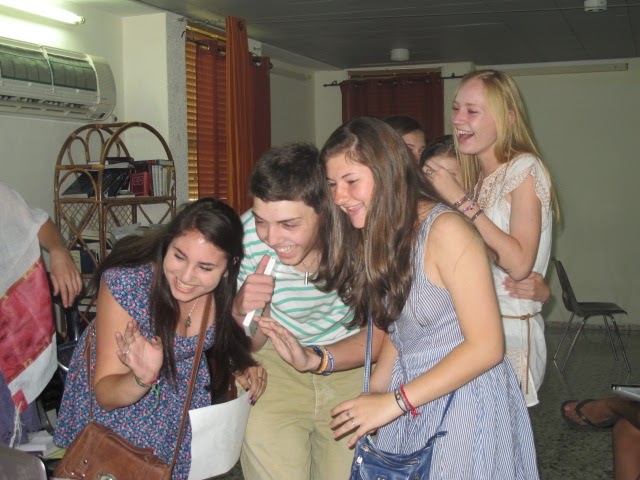
Sarah Stein, Matt Kalmans, and Molly Blumenthal celebrating with Sydney
(and  waving to Sydney's mom and brother on Skype!).  Mollie Rich and Ari Matz were also present.
The day after the Bat Mitzvah, we welcomed our new Israeli friends into our group. With them we conquered ropes course, went banana boating in the Kineret, spent a night in a Bedouin tent, rode camels and donkeys, woke up at 4 am to climb Masada and see the sun rise, rafted down the Jordanian River, and floated in the Dead Sea.

Now that we're in our last week, we hope to make it last as long as possible and to enjoy ourselves as much as we have this past month. Thank you and all of B'nai Israel for all of your love and support as we travel through the Holy Land, and we can't wait to see you soon!

Much love,
Molly Blumenthal, Michael Kalmans, Ari Matz, Alexa Molinoff, and Sarah Stein     

Sunday, July 31, 2011

Putting local food on your plate ... when you can

I've just recently returned from a Summer vacation in Ireland (hence the lack of blogging for a while).  As I so often do when I'm away, I took advantage of eating local foods whenever I could. Its part of the joy of visiting another place to not only sample the regional cuisine, but to look for locally grown ingredients in the food too - its always the freshest and the flavors are almost always vastly superior.  In Ireland that included eating some of the juiciest, sweetest strawberries I've had in a very long time, from a local Kerry farm.  And it included the joys of eating fish that had arrived at the dock of the very town we stayed in (Dingle) the very day we were eating it.

Arriving back in Connecticut, its the heart of the Summer farm produce season.  The tomatoes on our own deck taste so much better than anything available in the supermaket, and the fresh basil and parsley is now in abundance.  Living on the second floor of an apartment, we're not able to grow very much more of our own food at the moment, but we are not short of local places to buy.  There are farmer's markets every week, plus local farms (especially in Easton) where you can go straight to the source.  There are also independent small stores near our home, like A and J Farm Market in Southport or the Double L Market in Westport.  Some people plan ahead and sign up to CSA (Community Supported Agriculture) programs where they receive a weekly or bi-monthly delivery of fresh produce from a farm either delivered to their home or to a local pick-up point.  Its probably too late for this season, but you can learn more about these at local harvest (which also provides info on local farms and farmers markets in States across the country).

Buying local food is seldom the cheapest option, because we're usually dealing with small scale producers that cannot compete with huge agribusiness.  But I find that the intensity of flavors and overall quality makes me much more appreciative of what I'm putting inside of me and, subsequently, I eat less and more healthily.  It also encourages more creativity at mealtimes with meals based on what is in season and what was coming from the farms this week.  At eatlocalchallenge.com they have a top 10 list of reasons to eat local.

There's a lot of attention in the Jewish community these days to expanding our consciousness about food ethics.  I was reminded by a Jewish Youth Worker who I met at the URJ Kutz Camp this Summer who was from London that I've been teaching about Eco-Kashrut since the early '90s.  (It turned out, as we introduced ourselves, that she realized that I had been her Religious School teacher when she was 10, 20 years ago, and this was one of the things she remembered about my classes!).  I was inspired by teachers like Rabbi Arthur Waskow at The Shalom Center, who had been writing about it even earlier than that.

Today inspiration comes from organizations like Hazon and programs for Jews to learn about sustainable farming in the context of Judaism at places like the Adamah Fellowship program at Isabella Freedman Center or the Kayam Farm at the Pearlstone Retreat Center in Baltimore.  Many Jewish organizations and schools expose their children to Teva, which provides residential courses for youth to learn about Jewish environmental awareness and sustainability.


The CCAR Press (the publishing body for the Reform movement's Rabbinic association) recently released 'The Sacred Table: Creating a Jewish Food Ethic', edited by Rabbi Mary Zamore.  It is a wonderful collection that takes spiritual consciousness and ethics around issues of food from many different angles, offering a contemporary lens through which we can all think more deeply about the consequences of our day-to-day food decisions.  At B'nai Israel we are looking forward to welcoming Rabbi Zamore at our Shabbat author's series next Spring.

Saturday, June 25, 2011

A Pride Shabbat to Remember

As a congregational Rabbi, I don't have that many opportunities each year to visit at another congregation's services.  This year, after receiving an email from a friend who sings in the choir at Congregation Beit Simchat Torah - the LGBTQ congregation in New York City about their Pride Shabbat service, I found myself able to attend this year.  And what a year to be in New York City on the Friday night of Pride weekend.  To begin, the Shabbat service was quite wonderful.  The music is always something special at CBST, with the wonderful Joyce Rosenzweig (who also teaches at HUC) as music director.  The cantorial intern this past year was an incredible talent, Magda Fishman, who has just been invested as Cantor at the Jewish Theological Seminary.  Add to that the lovely, smart, funny, and passionate Cynthia Nixon, who was their Pride Speaker this year, and the Shabbat service itself was quite wonderfully crafted.

But of course, this year there was much more.  CBST adds in psalms of Hallel for their Pride Shabbat, recognizing the annual festive nature of the weekend.  This year the energy was one of anticipation and excitement that took the festivities to a whole new level.  It had become clear, just as services were beginning, that a vote on marriage equality in New York would take place in the NY Senate in Albany that night.  Toward the end of the service we'd received an update that the vote was likely to be approximately 30 minutes after the end of our service.

Outside the Stonewall Inn, waiting for the vote
And so, at its conclusion, many congregants gathered together to walk down to the Stonewall Inn.  We joined about 1000 people gathering in the street outside the bar, arriving just 10 minutes or so before the vote was taken.  Looking around, and speaking to the people around us, I was struck by the incredible diversity.  Many LGBTQ-identified people, but also heterosexual friends and allies who were there to share the moment.  And, the annual Drag Parade had finished just a short while earlier, so there was plenty of additional color and glamour added to the mix.

When the news came in, the crowd erupted in cheering and hugging and crying and laughing.  The celebratory atmosphere was incredible.  In the mix, the Jews who had walked down from CBST started dancing and singing 'Siman Tov u'mazel tov' and other Jewish wedding tunes.  A couple of Latino gay men came over to us, taken by the joyful sound and said, 'this is so wonderful - I wish we could be your friends'.  One of the CBST congregants took them by the hand and said, 'You are our friends' and they joined in the dance.

As one who wasn't even born at the time that the Stonewall Inn first came to fame in much darker times, it felt quite magical to be standing there at the moment that NY voted to give equal civil rights to homosexual couples.  Instead of police with batons, the police around the perimeter were friendly and smiling.  The feel-good on the streets and in the bars of Greenwich Village as people passed each other with smiles, cheers, and high-fives was a moment of feeling the community togetherness that can sometimes shine through in New York City.

The prophet, Isaiah (58:13) coined Shabbat as a time of oneg - pleasure, delight - a time to enjoy good food, to dress up, to enjoy each other's company, and to celebrate.  Last night was surely a pure and holy expression of Oneg Shabbat and it is one I will never forget.
Rabbi Rachel Gurevitz

Tuesday, June 7, 2011

Why we eat cheesecake on Shavuot (funny)

As my erev Shavuot posting, I wanted to share with you something deep and meaningful, about the essence of our holy festival ... Cheesecake! (or, if you prefer, blintzes).  Last week I was invited to offer my thoughts on any number of Shavuot-related questions for the Connecticut Jewish Ledger, and I chose to address the 'Why do we eat dairy?' question.  I wanted to take advantage of the opportunity to add my own spin on this question, partly because I've never been satisfied with any of the more 'traditional' answers and, partly, because I believe its possible to make something meaningful out of each and every moment and, therefore, each and every Jewish food, cheesecake being no exception.

So, what does a more traditional take on this question look like? Check out the short video answer provided by the United Synagogue of Great Britain (Orthodox):


To read my take on the background to eating dairy on Shavuot, the Ledger link is here (Scroll down for my answer on eating dairy).

But the best answer I've read this year was the one I received from my father.  Encouraged by what is clearly the Jewish tradition of having an endless number of answers to this vital question of Jewish practice, he decided to add a few more of his own.  Enjoy!

Qu:  Why do we eat cheesecake on Shavuot?


A: There are many answers, most , if not all, of them wrong. Perhaps the most credible answer, in the traditional Yiddish style, is "Why not?' Always answer a question with a question. This sharpens the mind and frays the nerves.

Another answer is that one day it was Shavuot and Rev Nachman was standing before his students wearing a white robe. With his pale skin he was barely identifiable against a pale background. One of his students was heard to remark: "Doesn't he look just like a bit of cheesecake" and this memory has been preserved ever since.

There is a lot more to Rev Nachman than a chair.

Another answer is that in olden times the harvest at Shavuot was celebrated by eating doughnuts. These doughnuts were the original kind, with a ring of dough sprinkled with sugar and a hole in the middle.Our sages and thymes tells us in an unconvincing, yet mystical, way that the ring represents all the Jews in the world and the hole ( which is not only in the middle but also occupies the surrounding space) is where God lives.

So no matter where you are, if you look, you will find God.

One day, around 1400 CE, a woman was buying doughnuts for Shavuot and said in a feigned middle-Eastern voice: "Ach, these fried doughnuts gives me heartburn; same with KFC. Haven't you anything else"

"How about a bit of cheesecake?" replied the baker. "Ok, I'll try a piece" said the lady.

And she never had heartburn again, dying peacefully the following day.

"A miracle" exclaimed the baker and Jews have been eating cheesecake on Shavuot ever since in the hope that they, too, might be delivered from heartburn.

Although this rarely happens, they have not stopped trying.
Simon Gurevitz
(Not a Rabbi)

Monday, June 6, 2011

The Weiner Saga - what it can teach us about ourselves

Anthony-Weiner-100x100.jpgThere's a lot of online chatter, blogging, tweeting, and more about Anthony Weiner's use of the social network to communicate with women via lewd photo.  If you need an update on the full story, here's a piece in the NYTimes, and another on The Huffington Post.

So, I want to get my 2 cents in? Well, yes and no.  I don't think I have much more to add to what has already been said about the unbecoming behavior, the lying, the damage to Weiner's family (and, particularly, his wife) and friendships, the analysis of his confession, etc. etc.

But I want to look at another aspect of the chatter online.  Because expressing our disgust, our disappointment, and our judgment, while appropriate, is the easy part.  Especially when it involves a public official or celebrity.  The much harder part is to look at our own lives and ask ourselves some of the really tough questions that emerge from stories like these.

Unless you happen to hang with a particularly angelic crowd, how many of us can say that we don't know someone among our friends, our congregation, or community, who has done something deceptive or foolish in their lives?  How many of us can look in the mirror without feeling embarrassment for a poor judgment of the past?  Whether it was behavior while drunk or high, a lie that had consequences that we've never owned up to, an email that should never have been sent, a touch or a kiss that betrayed the trust between committed couples, a full-blown affair or a criminal act ... Weiner can be a painful reminder of our own faux pas, or remind us of the pain caused by a friend or family member who did something to cross the line.

I remember that, as a very young child, perhaps no more than 6 or 7, I had a teacher who supervised a sewing activity with my class each week.  We had learned different stitch styles and were making a bookmark.  One week, I made a mistake.  I was so embarrassed by my mistake that, instead of going to the teacher for assistance, I tried to fix it myself and created a big knot in the middle of my fabric.  Then I panicked.  I thought she'd be furious with me if she saw the mess I'd made instead of getting help when the problem was still small.  So I started to feign sickness right before her class, and my grade teacher would allow me take some time out in the fresh air and miss her class.  After a couple of weeks of this, they caught on.  When the confrontation finally occurred, the teacher was mortified that I'd been too afraid to ask for her assistance;  with one snip of the scissors she removed my knot and helped me get back on track.  We had a great relationship from that point on.

Ok, so its a pretty innocuous example, but I offer it more for symbolic value.  What Weiner did was very human.  He messed up.  Yes, he should examine what created his desire to exhibit such behavior in the first place - that is different from my accidental stitching mistake.  But what followed is where the commonality lies, and is not at all uncommon.  Once we've messed up, we're embarrassed and ashamed. We're fearful of what people will think and say.  We're fearful of the consequences.  And so we do things in a vain attempt to try and control the situation.  This usually involves a lie.  Sometimes its a total cover-up lie (no, I didn't do that; my account must have been hacked), and sometimes its a lie disguised as a partial admission of a lesser crime to try and divert attention from anyone discovering the true depths of our deed.  When it looks like we've got ourselves into an almighty knot, we try a different strategy, perhaps feigning illness - 'I wasn't in my right mind'; 'I was under a great deal of stress at the time', 'I hadn't gotten over the death of my father' ...

Only when we find ourselves cornered and out of options might we finally come clean and confess.  And we tell people how truly sorry we are.  And its not a false confession.  It might look that way, because it looks like we've been lying and were hoping to get away with it.  Would we have confessed if we hadn't been found out?  Probably not.  But the lack of confession until there was no other choice does not necessarily indicate lack of authenticity.  We are ashamed, we are embarrassed, we hate ourselves for our poor judgment and the hurt we have caused to people we care about, the trust we have lost, and we are disgusted by our flaws and inadequacies that have caused so much harm.  It was all those feelings and emotions that led us to try and cover things up in the first place - out of our desire to nullify the harm and make it all go away.  Hindsight is 20/20, as they say; we did not have the foresight to consider how much worse we were making the knot by our avoidance.

What is true of ourselves also plays out in our dealings with others.  When someone you love is guilty of an act of hurt, or poor judgment, how do you respond?  When they show true remorse and want to do whatever they can to bring some healing to the situation, do you push them away or do you try to make a path for them to do teshuvah - return/repentance?  There are no easy answers; sometimes we have to separate ourselves from an abusive or narcissist personality.  Sometimes we need time to mourn what has been lost - love, trust, friendship - before we can forgive.  But it is always worth taking a breath and a step back and asking ourselves if there is any room for compassion alongside our judgment of the sins of another.

Rabbis, as with all clergy, find ourselves engaging pastorally with people in every aspect of life's journey.  We seek to help those who have been hurt by another to find peace and to heal, and we seek to listen and help those who have sinned to do the inner work of true repentance, taking responsibility, but also the ability to heal and to move on rather than to carry the weight of their error forever.

So, yes, Anthony Weiner has messed up and, yes, he has more work to do.  But there's a spiritual lesson here, and its a lesson that requires deep contemplation ... for each and every one of us.
Rabbi Rachel Gurevitz

Wednesday, June 1, 2011

Clergy speak out for Gay Pride month

June is Pride month.  These days my attention is turned much more to highlighting and celebrating the diversity of all kinds within our Jewish communities.  In the past, some of our Jewish communities have specifically addressed the inclusion of interfaith families and GLBTQ Jews in their midst.  In recent months I've learned a great deal from my colleague and friend, Rabbi Ruth Abusch-Magder, Rabbi-in-Residence for Be'chol Lashon, that recognizing and responding to diversity goes far beyond these categories, to the inclusion of Jews of every ethnic background.  Our worldwide Jewish community has always been diverse, but our US-based community is becoming increasingly more diverse from immigration, adoption, conversion and the coming together of more mixed-ethnicity couples in marriage.  A new video from B'chol Lashon, featuring Y-love (below) shares this message:


But one of the important aspects of being a welcoming and inclusive community is not simply to acknowledge, welcome and celebrate the diversity that makes up our Jewish communities today.  If we really care about inclusivity, we need to be responsive to the hurts, the needs, and the injustices that may be faced by one part of our community.  For just as we cannot claim to be an economically diverse community that welcomes everyone to belong regardless of financial means if we do not make it possible in reality and do not see it is as our duty to provide additional support to our families in times of struggle, so we cannot claim to be truly inclusive and welcoming of any group if we are not responsive to their needs.

I recently heard a story of a Rabbi who had delivered a sermon on a Pride Shabbat that highlighted some of the injustices and inequalities still faced by loving same-sex couples because they cannot get married or their marriages are not federally-recognized.  Couples who are still faced with crippling financial ramifications when one dies and their partner inherits; couples who cannot gain access to each other when one is in the emergency room, and cannot make decisions on behalf of an incapacitated partner; couples who struggle to find affordable health insurance that is available to them as a family unit.  And the list goes on.  While the overwhelming majority of the community responded with compassion, recognizing that the Reform movement has long stood behind civil rights equality for same-sex couples, and recognizing the holiness of being a community dedicated to that work, a small minority felt it inappropriate material for a Rabbinic sermon.  But the wonderful 'It Gets Better' campaign this past year has helped us all understand that silence on the pain and inequalities facing GLBTQ people is more than just an omission of words; by making the individuals and the issues invisible in our communities we are failing in our duties to literally save the lives of some of our youth who don't know who to turn to and what wonderful possibilities might lie ahead.  I spoke (and subsequently published in my blog here) about this specific issue some months back, and recently a colleague, Rabbi Andrea Myers, published an article on the Huffington Post entitled 'It Gets Beautiful', which I highly commend to you.

The seminary of the Union for Reform Judaism, Hebrew Union College-Jewish Institute of Religion, created their own 'It Gets Better' video, providing inspiring leadership.  More recently, the students at Yale Divinity School created a similar video project, reaching out to Christians who are looking for their spiritual home in a place that doesn't require them to leave a piece of their soul at the door.  Both videos are below.
Blessings for a Pride month filled with inspiration, affirmation, and action.
Rabbi Rachel Gurevitz